







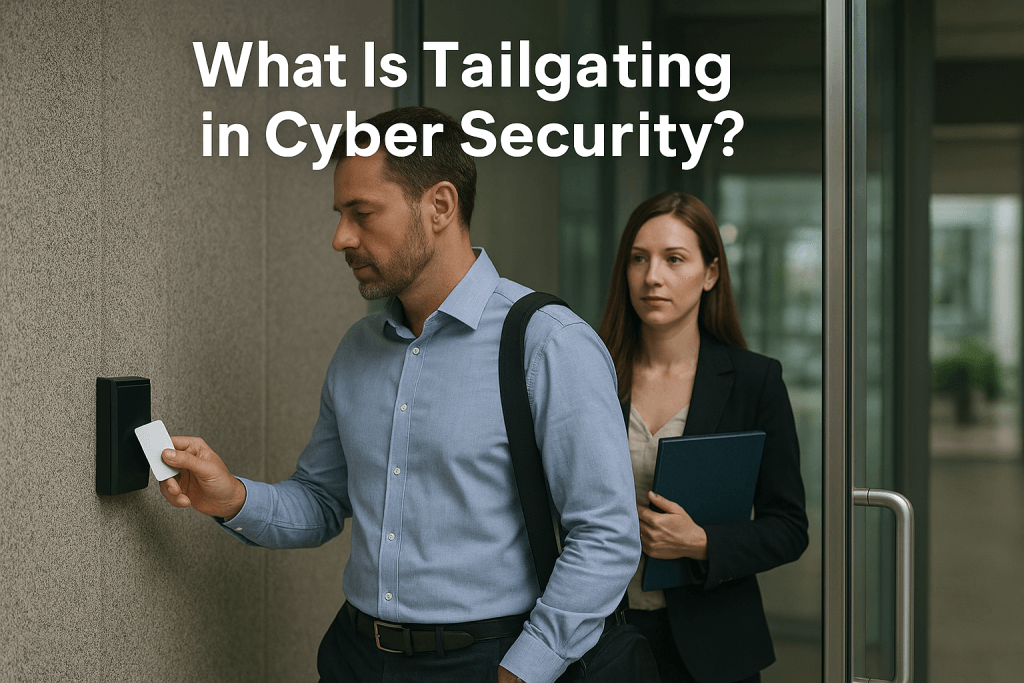
What Is Tailgating in Cyber Security
Tailgating in cyber security is a subtle but high-impact vulnerability in physical access control. It happens when an unauthorized person follows an authorized employee into a restricted zone without challenge or authentication. Even in organizations running advanced zero-trust models, one “kind gesture” of holding the door open can dismantle millions in investment. According to the 2025 Verizon Data Breach Report, physical-layer breaches still account for 41 percent of total compromise cases—tailgating remains a top-five factor. The problem isn’t the door; it’s the blurred interface between human courtesy and digital discipline that most companies fail to engineer systematically.
Tailgating vs. Piggybacking
Though often interchanged, tailgating differs materially from piggybacking. Tailgating involves unauthorized access without consent, while piggybacking is access granted through courtesy by someone with authority. For governance teams, the distinction defines responsibility, liability, and insurance eligibility. Misclassification can lead to incomplete incident documentation or failed ISO 27001 and SOC 2 audits. Forward-looking CISOs now include separate KPIs for tailgating and piggybacking under their physical security risk dashboards, ensuring both awareness and accountability.
Tailgating misclassification also affects Cybersecurity Compliance maturity scores, especially in ISO 27001 Annex A controls and SOC 2 Physical & Environmental safeguards. Enterprises that map tailgating incidents into their compliance workflows show 27% higher audit readiness.
Why It Matters to Businesses
Tailgating doesn’t just threaten data—it destroys operational trust and compliance posture. A 2024 incident in the European manufacturing sector began when an outsider entered a network lab behind a facilities engineer. The intruder attached a rogue access point, exfiltrating credentials that later appeared in a ransomware campaign. The event caused three weeks of downtime, supply-chain delays across four plants, and an estimated $1.6 million in direct loss. More critically, the breach downgraded the firm’s cyber-insurance rating, raising next-year premiums by 12 percent. Preventing tailgating is therefore not just a security measure—it’s a financial safeguard.
Three-Layer Defense Framework
An effective enterprise strategy integrates people, process, and technology. Each layer strengthens the other to create a measurable loop of protection.
1. People and Culture
Employees represent both risk and remedy. Security Magazine found micro-learning improves recall 70 percent better than annual lectures. Signalage.com applies this insight through adaptive digital signage near entry points, automatically rotating awareness messages depending on time, risk score, and department. The screens log dwell time and reaction patterns, feeding analytics into HR compliance dashboards so that leadership correlates awareness with KPIs like “Access Challenge Frequency” or “Badge Compliance Rate.” Over six months, adopters report a 35 percent rise in challenge behavior—a culture of curiosity replacing passive politeness.
2. Process and Governance
Structured processes prevent “courtesy bypass.” Corporates now embed tailgating metrics directly into Governance, Risk & Compliance (GRC) routines. Badging logs sync with attendance data to detect mismatches; monthly dashboards visualize deviations by department. In organizations where executives review these numbers with their teams, non-compliant entries drop 32 percent within two quarters. Incentivization converts awareness into results—linking department bonuses to adherence makes “door discipline” a measurable KPI, not an optional formality.
3. Technology and Infrastructure
Hardware and analytics form the tangible layer, where ROI often gets scrutinized.
| Control System | Core Function | Typical ROI | Key Limitation |
|---|---|---|---|
| Turnstile Gate | Ensures single-entry authentication | 12 months | Requires large floor space |
| Mantrap Portal | Dual interlock with pressure sensors | 18 months | Expensive and slow throughput |
| LiDAR Sensor | Detects multiple bodies per badge | 7 months | Needs periodic calibration |
Signalage.com’s Access Communication API consolidates all devices within a single data fabric. The API links HR, security cameras, and door controllers; when an employee’s status changes in HR, access privileges revoke instantly, cutting deactivation latency by 45 percent. This same feed integrates with Power BI dashboards, allowing executives to compare physical access compliance with cyber hygiene scores—bridging a gap few vendors currently close.
ROI and the CFO Perspective
For CFOs, “prevented loss” is a primary proof-point. Gartner’s 2025 benchmark shows integrated access ecosystems yield payback in under nine months. Consider a company that invests 250,000 in hardware, training, and Signalage software. If an verage physical breach costs 132,000 and the investment avoids three per year, the ROI exceeds 145 percent in the first twelve months. Signalage’s ROI Calculator lets finance teams input employee count, facility size, and risk tolerance to visualize scenarios before committing budgets. This quantitative framing transforms security from a cost center into an enterprise enabler that directly supports EBITDA protection.
Beyond direct loss prevention, the long-term ROI also emerges from reduced insurance premiums, fewer overtime hours for security personnel, and lower maintenance on legacy systems. Companies quantifying these side benefits often reveal hidden savings of 80 K–120 K per site annually. Such holistic accounting reframes the CFO’s dialogue from “risk mitigation” to “operational efficiency,” reinforcing the financial logic behind proactive physical security investment.
Operational Intelligence via Signalage Integration
Beyond access control, Signalage delivers an analytics advantage. Its unified platform merges badge scans, CCTV motion streams, and temperature or lighting sensors into one behavioral graph. The AI module learns typical occupancy patterns and instantly flags anomalies—like two entries under one badge or doors left open longer than five seconds. These alerts push to the organization’s SIEM or SOAR system alongside cyber alerts such as suspicious logins.
Combining physical and logical anomalies, security teams reduce Mean Time to Detect (MTTD) by 42% and Mean Time to Contain (MTTC) by 33%. For businesses in Irvine looking to unify their physical security with IT excellence, our managed IT services in Irvine deliver integrated monitoring, threat response, and compliance reporting across both digital and physical domains.
Key Performance Indicators for Executives
Leaders can track tangible progress through a concise KPI set:
- Unauthorized entry rate < 0.5 %
- Door-hold events < 5 per month per site
- Staff challenge frequency +30 % YoY
- Sensor accuracy ≥ 98 %
- Awareness retention ≥ 90 %
Visualizing these indicators beside ISO 27001 control mappings gives audit committees assurance that governance is data-driven, not policy-only. When such metrics appear in quarterly reporting next to ROSI (Return on Security Investment), boards finally perceive security as a function of efficiency, not paranoia.
Implementation Checklist
1. Badge-per-person protocol across all facilities
2. Merge access logs with SIEM for unified alerts
3. Deploy adaptive Signalage screens at entrances
4. Audit doors randomly every quarter
5. Link KPIs to leadership bonuses
6. Assess energy savings as ESG gain
7. Apply vendor training parity with staff
8. Benchmark incidents vs. peers annually
9. Run red-team simulations capturing physical gaps
10. Use Signalage.com’s Anti-Tailgating Toolkit for baselining budgets and compliance
Executive Outlook
Tailgating exposes the enduring conflict between human instinct and procedural rigor. The goal isn’t to suppress courtesy but to engineer it responsibly through design, analytics, and incentives. Forward-thinking enterprises treat every door as a sensor and every passer-through as a data point in the security story. With the integrated approach led by Signalage.com, physical security evolves from a static control to a dynamic intelligence layer—transforming protection into measurable business value for every CISO and CFO in the modern B2B landscape.
Executives pursuing measurable resilience should commission a Physical Access ROI Audit with Signalage.com to benchmark their facilities against 2025 industry standards. A guided demo reveals how real‑time analytics convert entry data into KPIs that drive board‑level confidence. Visit Signalage.com/contact to initiate assessment and turn compliance upgrades into quantifiable performance growth
Quick Checklist: 8 Steps to Cut Tailgating Risks
- Schedule quarterly awareness sessions—keep it conversational.
- Reinforce barriers on vulnerable doors.
- Use visible reminders: “Verify Access Before Entry.”
- Review visitor escorts weekly.
- Monitor entry points via camera or sensor.
- Simulate a fake breach monthly to test awareness.
- Praise quick reporting, not just flag mistakes.
- Automate anomaly alerts.
- Refresh internal policy yearly.
(Signalage offers some of these options on their site.)

FAQ
Is following someone into a building always tailgating?
If they’re verified or escorted—fine. If not? Yes, it’s a major security violation.
Can tailgating lead to cyber breaches?
Absolutely. Verizon’s ongoing data shows about one in four hybrid breaches start this way.
How do mantraps work?
Simple: the outer door locks before the inner one opens, ensuring only one verified user passes at a time.
Conclusion
Tailgating usually starts small—a shared elevator ride, a held door, a flash of trust. But that quick courtesy can open a path straight into your private digital world. The fix isn’t paranoia; it’s smarter awareness backed by systems that have your back when instinct fails.
Combining cybersecurity consulting with intelligent building design, businesses in Irvine can implement holistic security solutions through Cybersecurity Services Irvine, bridging physical and digital defenses seamlessly.”
Brands like Signalage are redefining secure entry by blending tech with human design—keeping workplaces open, but never unguarded.
