


Cybersecurity Specialists: The Frontline of Business Protection (and Why You Need One)
Digital threats are evolving faster than ever and organizations need qualified people to protect their systems. The cybersecurity specialist is the buffer between your organization and today’s chaotic cyber attacks, representing the last line of defense to your revenue streams, customer data, and reputation to the business.
If you are a CIO, IT Director, or business leader determining your security posture, knowing what an organization can expect to receive from a cybersecurity specialist for your business and if it is more prudent to build the capability in-house or connect with a managed security service provider will help you with your chapter for protecting your assets while reducing the security budget.
Defining the Role and Core Responsibilities
A cyber security expert will safeguard your revenue stream by exercising threat detection, risk reduction, and security architecture – avoiding breaches, slowing downtime, and ensuring compliance.
- Detection: cybersecurity specialist analyst watches your company’s network from the inside with enterprise-grade SIEM tools, detecting anomalies related to unauthorized access and suspicious behavior to neutralize threats before they can disrupt operations, compromise data, or produce regulatory issues.
- Protection: A cyber security analyst builds layered defenses such as next-gen firewalls, granular access controls, and timely patches to help evade attacks and verify that they work in the real world. If an incident occurs, the analyst can quickly contain damage, isolate the compromised systems, and recover in order to minimize the disruption to the business.
Core Responsibilities & Tasks
A cyber security specialist distinguishes real threats from bogus alerts, providing 24/7 SOC monitoring, analyzing a scenario, and escalating as necessary. When either building an internal team or partnering with Signalage, understanding the different skill sets required for SOC and incident response roles is important.
Vulnerability Assessment & Patch Management
A good cybersecurity specialist will find the security holes and misconfigurations that an attacker will exploit before the attacker ever becomes aware of them. Detecting vulnerabilities will utilize automated tools and manual assessments of your systems, applications, and networks.
Once vulnerabilities are detected, the cybersecurity specialist will rank the vulnerabilities against a framework such as CVSS or NIST, then they’ll schedule updates or changes to the IT team, and perhaps test fixes in a staging environment to make sure security updates don’t conflict with operations or business systems.
Incident Response & Basic Forensics
action no time for panic, indecision, and hesitation. They implement incident response playbooks to contain threats, isolate affected systems, and capture forensic evidence for insurance, legal, or regulatory requirements.
As part of their forensic tasks, they analyze logs, inspect memory for malware, and follow the attacker’s trail and performance reviewing these logs is detective work that is critical to safeguarding your business reputation, customer trust, and financial health.
Identity & Access Management (IAM) & Zero Trust Basics
Modern security architecture adheres to a zero trust model where a cybersecurity professional is always validating every access request rather than simply relying on location or behavior patterns, they use IAM solutions, enforce least-privilege access, deploy multi-factor authentication, and regularly review access to sensitive systems and data.
Essential Skills & Tools
Evaluating a cybersecurity specialist goes beyond technical certificates or degrees.
- Technical skills: A capable cybersecurity expert requires a competent foundation in networking knowledge, working experience in both Linux and Windows platforms for threat detection, and also knowledge of Python or PowerShell scripting for automating tasks that allows the cybersecurity professional to concentrate on advanced analysis or behavioral profiling.
- Security Tools: A capable expert in cybersecurity employs SIEM tools for quick identification of threats, EDR solutions to investigate attacks on endpoints, IDS/IPS systems to observe network traffic, and vulnerability scanners to find security flaws and remediate them before they can be exploited.
- Soft Skills: A strong cybersecurity professional defines complex threats in terms relevant and grounded in business practice, while also presenting risk assessments, actionable recommendations, and budgets that keep executive management informed to formulate decisions about security.
Certifications & Training Path
Certification | Level | Cost Range | Prerequisites | Best For |
CompTIA Security+ | Entry | $370 exam | None | Junior specialists, career changers |
CEH | Intermediate | $1,199 exam | 2 years exp OR training | Specialists needing offensive skills |
CISSP | Advanced | $749 exam | 5 years exp | Senior roles, management track |
GIAC (GSEC) | Intermediate | $1,899 exam | None required | Technical depth, government work |
Vendor Certs | Varies | $100-$400 | Varies | Platform-specific expertise |
How to Measure Impact (for Employers)
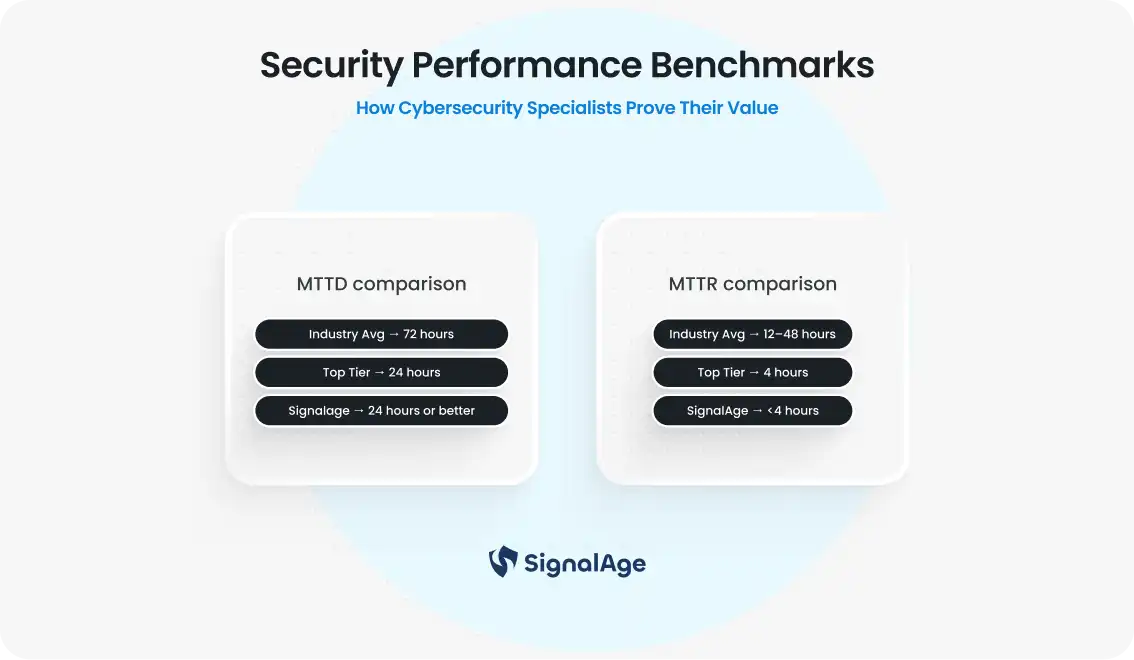
A proficient cybersecurity practitioner will rely on measurable metrics to show evidence of security effectiveness. MTTD (Mean Time to Detect) shows how quickly threats are detected, with top performers akin to 24 hours, much faster than others in their industry. MTTR (Mean Time to Respond), from detection to full remediation, shows when the best-in-class response occurs within four hours and mitigates profitability losses from incident disruptions, data compromise, and other damages.
The Strategic Decision: In-House vs. Managed Security Service Provider
When determining the security strategy, organizations may choose to invest into internal cybersecurity specialist with the risk of market difficulty for employee recruitment or contracting with an MSSP like Signalage for rapid access to SOC, round-the-clock monitoring, and on-demand services.
A common practice of many mid-market organizations is a hybrid approach; here the internal lead is responsible for the security strategy while the MSSP is responsible for monitoring, threat detection, incident response, and regulatory compliance allowing the benefits of internal visibility and external practice.
How Signalage Can Help
Signalage delivers proactive, business-focused cybersecurity that protects operations and builds trust.
- Security is about protecting operations, customer trust, and enabling growth, not just tools or certifications.
- Signalage’s SOC team provides 24/7 monitoring using SIEM, EDR, and up-to-date threat intelligence.
- We investigate real threats, filter false positives, and respond to incidents quickly.
- Average MTTR for critical incidents is under four hours.
- Regular vulnerability assessments, penetration tests, and security audits prevent attacks before they happen.
- We support compliance with PCI DSS, HIPAA, SOC 2, and ISO 27001, including technical controls and audit documentation.
- Monthly executive dashboards track MTTD, MTTR, remediation rates, and incidents for clear reporting and investment justification.
Signalage provides end-to-end Cybersecurity Consulting, helping organizations assess risk, identify compliance gaps, and design tailored security roadmaps.
Conclusion
We can help whether you are starting with a blank slate or building off what you already have in place by providing you with expert counsel, manned procedures, and business-grade infrastructure to help you with modern threats.
At any time, schedule a free consultation with us so that we can review your risk profile, look for any areas for improvement, and give you tailored recommendations along with transparent pricing and timelines.
If you would like a free comprehensive security assessment from Signalage, get in touch with us, and we can discuss the managed services we have to offer to help protect your business.
We also support all phases of Cybersecurity Compliance, from implementing technical safeguards to preparing the documentation required for PCI DSS, HIPAA, SOC 2, and ISO 27001 audits.
Schedule a consultation today with our Signalage’s Irvine IT team to secure your business.
Frequently Asked Questions
- What does a cybersecurity specialist do? A cybersecurity specialist monitors systems against threats, investigates security alerts, responds to incidents, manages vulnerabilities, and implements controls to protect organizational data and infrastructure.
- Which certification to start with: CompTIA Security+ is considered the perfect entry-level cybersecurity specialist certification that will cover the very foundations of security.
- What is the difference between a cybersecurity specialist and a security engineer? Well, the big difference between cybersecurity specialist versus security engineer has to do with the focus of the job.